

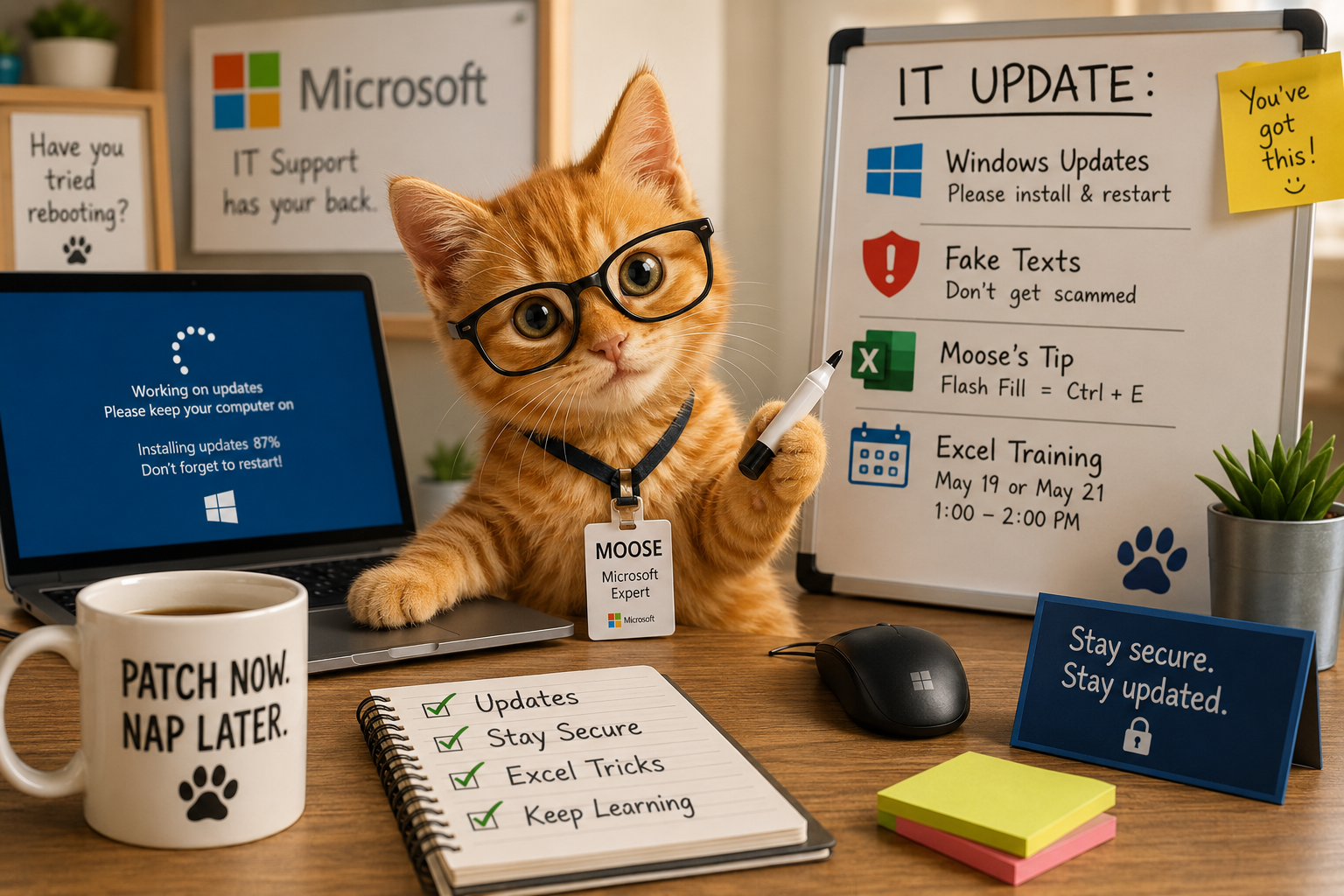
My AI minions learned how to be cats. Specifically, they learned how to be three very specific cats with consistent personalities, recurring catchphrases, and an unreasonable amount of opinions about multifactor authentication. One step closer to world domination, but first, somebody actually has to read the email.
This is a post about internal IT communications, which is the thing every IT leader knows they should be doing better and almost nobody actually is. It is also a post about a lesson I learned at Fox Studios more than a decade ago that I have been quietly running ever since. The cats are the new part. The lesson is old.
The Fox Studios Email
I was running the helpdesk team for Fox Studios as part of an MSP engagement(Over a decade ago… Damn I am getting old!). Standard MSP work, except for one wrinkle. The Fox internal communications team had figured out something that should have been obvious to all of us in IT and somehow was not. Staff would read an email if it had a familiar cartoon character in it. Bart Simpson selling a security reminder. Homer reminding people to log off before leaving for the weekend. A Family Guy character announcing the next planned maintenance window.
The emails were getting opened. The reminders were landing. Compliance numbers on the boring stuff like password resets and laptop returns were actually moving.
So they started having me send the emails.
Not the comms team. Me. The MSP helpdesk manager. Because the second wrinkle they had figured out was that staff would read an email if they perceived it was coming from a specific person they recognized, with a specific voice, and with something a little different each time. Branded, character-driven, slightly varied. That was the formula.
I did not have a formal background in internal communications. I had a service desk to run and tickets piling up. But I sent those emails for more than a year, and I watched what happened. Click-through rates that no generic IT email had ever pulled. Replies that started with “I saw your email” instead of “I didn’t see any email about that.” Staff stopping me in the hallway to ask follow-up questions about something I had sent three weeks earlier.
That should have been a corporate communications case study, not a helpdesk side project. But it was where I learned the rule I have run on ever since.
The Principle Behind Internal IT Communications That Get Read
Here is what I extracted from those years of Fox emails, written as plainly as I can say it. Staff will read an email if two things are true at the same time. They perceive the author as a person rather than a department. They perceive the format as fresh rather than templated.
Both pieces matter. A personal voice with a stale format gets skimmed. A varied format from an anonymous IT@company.com inbox gets deleted. You need both, every time, or the open rate collapses.
This is not a marketing principle. It is an attention principle. The same brain that ignores the seventeenth identical Slack notification will pause for the eighteenth one if it looks different. Marketing teams have known this for fifty years. IT departments have somehow decided it does not apply to us.
It applies to us. The compliance gap on your last MFA rollout is not a training problem or a buy-in problem. It is a readership problem. Your staff did not refuse to set up MFA. They never read the email that told them to set up MFA, because the email looked exactly like every other email you have ever sent them.
The Modern Version of That Lesson
Fast forward to now. I am the CIO at Crimson IT Services, I serve as vCIO for several clients, and I write staff IT updates for multiple organizations every week. The volume that would have crushed me ten years ago is routine now because I have built a two-agent system that handles the heavy lifting.
The first agent writes the copy. It knows the voice for each client, the tone we use for that organization, the cadence of their weekly updates, and the specific terminology their staff actually uses. It drafts the email body, the subject line, and the call to action. I review and edit, but the structural work is done before I touch it.
The second agent generates the visual. Same brief, different output. It produces a mascot image specific to that organization, in a consistent style, with a fresh setting and a new visual joke every time. Same character. New scene. New whiteboard message. New mug slogan. New post-it on the monitor.
The two outputs land together in a draft I can finalize in about ten minutes per email. Pre-agents, this used to take me ninety minutes if I was being honest about how long it really took. Now it is built into the rhythm of the week, and the time savings have been the difference between sending these communications reliably and dropping them whenever the week got busy.
The Cats Were Not Planned
I want to be transparent about something. I did not sit down one day and decide to create a cat mascot system for staff communications. The cats happened because I have two actual cats, Brie and Moose, who became running characters in my emails the way office pets sometimes do. Then a third cat, Aoife, showed up in the prompt one day as the office security kitten for a different context, and she stuck.
What happened next was the interesting part. The cats developed personalities because the image agent kept generating them. Brie became the mascot for one of my client environments, a tuxedo cat who is patient, slightly judgmental, and good at delivering monthly security tips. Moose anchors a different client environment, an orange tabby who handles training reminders and Microsoft updates with the air of a kitten who has read more documentation than you have. Aoife is the office security kitten, a small black cat with strong opinions about phishing and badge access.
None of this was planned. All of it was emergent from running the system consistently over weeks and months.
But here is the part that matters. Once the cats had personalities, the staff started looking forward to them. People stop the conversation when a new Moose email comes in. Staff send me Brie fan art. A new hire at one of my client orgs sent her manager a screenshot of an Aoife email on her first day with the caption “this is my favorite part of working here so far.”
That is the readership signal you cannot fake. That is what Fox figured out with Bart Simpson and what I figured out by accident with Brie.
Why This Actually Works
The mechanic is simpler than it looks. A recurring mascot gives you brand consistency, which means staff recognize the email format instantly. The mascot’s varied scene gives you novelty, which means they stop to actually look at it. The mascot’s voice gives you a perceived author, which means they read it as a message from someone rather than from a system. All three boxes get checked in one image and one email.
The agent system is what makes it sustainable. Without the agents, I would have stopped doing this six months in because the time investment per email would not have scaled across multiple clients. With the agents, the marginal cost of each email is small enough that I can run this for every organization I touch and still have time left over for the rest of the job.
The cats are a nice creative layer, but the cats are not the point. The point is the system underneath. Replace the cats with a different recurring character and the principle still holds. The principle is that you are running internal IT communications like a brand, with a consistent voice and a varied format, and you are using AI to make that economically possible at the scale a real IT leader actually operates at.
How to Start Without an Agent Ecosystem
You do not need a stack of Claude Code agents to start improving your internal IT communications. You need three things.
First, pick a recurring character or visual identity. It can be an actual mascot like a cat, a dog, or an office plant that has become an inside joke. It can be a visual style like a specific whiteboard format or a recurring meme template. It can be a written persona that signs every email. Just pick one and commit to it for at least six months before you decide whether it is working.
Second, write in a consistent voice. Use the same opening pattern, the same sign-off, the same way of framing the action you want staff to take. The voice is what makes staff perceive the author as a person rather than a faceless ticketing queue.
Third, vary the format inside that consistency. Different setting, different joke, different scene, different reference. The variety is what makes staff actually look at it instead of pattern-matching it to last week’s email and skipping past it.
You can do this with Canva and a copywriting habit. You do not need agents. The agents make it scalable, but the principle works at any scale, and the open rates start moving as soon as you commit to the format.
What I Would Tell My Fox-Era Self
If I could go back to that helpdesk manager sending Bart Simpson emails about laptop returns, the advice would be simple. You are doing real internal communications work. Treat it like a discipline, not a side gig. Build a system around it. Track what gets opened and what gets ignored. Iterate on the format. Keep the voice consistent. Keep the visuals fresh. Trust the principle that perceived authorship plus visual variety equals readership, because it does not stop being true just because you moved from a studio to an MSP to a CIO chair.
And eventually, get yourself some cats.
What Comes Next
I am writing a deeper post on the two-agent system itself, including how the copy agent and the image agent share a brief and how I keep the cat personalities consistent across hundreds of generations. That one is for the IT leaders who want to build their own version. This post was about the why. The next one will be about the how.
In the meantime, look at your last five internal IT communications. Ask yourself two questions. Did they read like they came from a person, or from a department? Did they look different from each other, or did they look like the same email five times in a row?
If the answers are department and same email, you have a readership problem. The fix is older than I am, and it works.